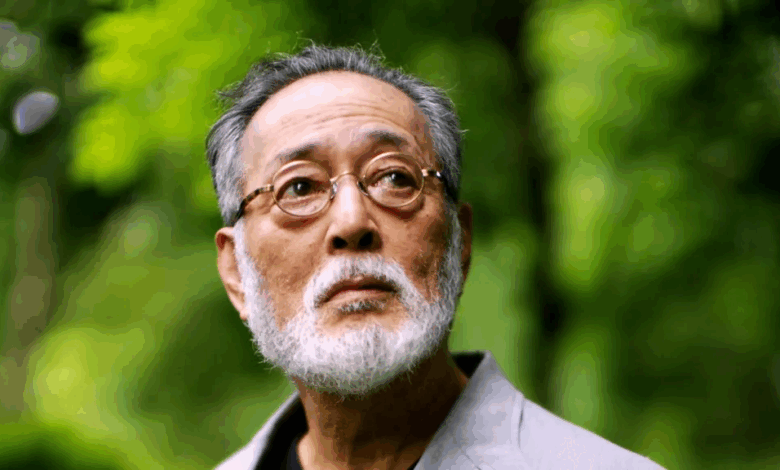
Tatsuya Nakadai is one of the most remarkable figures in the history of Japanese cinema, a performer whose presence on screen carried a depth that transcended language and culture. His face – poised, intense, and filled with quiet storms – became one of the defining images of classical Japanese film. Nakadai belonged to a legendary generation of actors who reshaped the identity of Japanese cinema, working closely with directors such as Akira Kurosawa, Masaki Kobayashi, Mikio Naruse, and others who built the foundation of what we now call cinematic modernism in Japan.
Born in 1932, Nakadai’s path toward acting was neither straightforward nor planned. Like many artists of his era, he began his professional life far from the world of cinema. His early years were shaped by postwar Japan’s challenges, and he worked various jobs simply to make a living. But a chance encounter with a talent scout pushed him toward the stage. His deep-set eyes, restrained expressions, and natural gravitas made him unforgettable even in auditions. Within a short time, he attracted the attention of some of the most influential directors of his time.
One of the first major turning points in his career was his collaboration with Masaki Kobayashi. Kobayashi believed in an acting style rooted not in exaggeration, but in patience, silence, and emotional precision. Nakadai fit perfectly into this world. Their work together in films like Harakiri remains among the most powerful examples of Japanese period drama. In Harakiri, Nakadai portrayed a samurai burdened by suffering, injustice, and quiet rebellion. The performance was not built around large gestures or dramatic speeches; it was built on stillness, controlled breathing, and a gaze that revealed more rage and sorrow than words ever could. Critics still consider this role one of the finest of his career.
His partnership with Akira Kurosawa deepened another aspect of his artistry. Kurosawa’s films demanded physical intensity, psychological complexity, and moral conflict. Nakadai rose to the challenge with striking versatility. In Yojimbo, he appeared opposite Toshiro Mifune, delivering a presence that was equal parts threatening and magnetic. Later, in Kagemusha, he played a breathtaking dual role; a thief forced to impersonate a powerful warlord. The character required Nakadai to convey power without authority, confidence overshadowed by fear, and leadership built on illusion. It was a masterful expression of identity, fragility, and performance within performance.
Perhaps his greatest achievement with Kurosawa came with Ran, an adaptation inspired by Shakespeare’s King Lear. Here, Nakadai embodied a king descending into madness, betrayal, and spiritual collapse. The intensity of his performance elevated the entire film. He expressed the tragic unraveling of power not through loud breakdowns, but through gradual shifts in body language, subtle tremors of the voice, and eyes that revealed a soul disintegrating under the weight of consequence. Many critics consider Ran one of the greatest performances not only of Japanese cinema but of world cinema.
What sets Nakadai apart from many great actors is the distinctly Japanese minimalism in his technique. He did not rely on dramatic physicality or emotional outbursts. His craft was internal. A slight movement of the jaw could signal resignation; a slow blink could communicate trauma. This minimalism is not emptiness; it is concentration. It is the art of doing little so that the audience can feel much. Nakadai often said that acting is “the art of observing.” He watched people carefully: their pauses, their hesitations, their unspoken thoughts. When he recreated these behaviors on screen, the result felt authentic, intimate, and deeply human.
His range, however, extended well beyond samurai epics. Nakadai was equally capable of portraying modern, ordinary men struggling with the social and emotional complexities of postwar Japan. He appeared in family dramas, psychological films, and contemporary stories that explored guilt, generational conflict, and moral ambiguity. This versatility made him more than a symbol of classical Japanese cinema; he became its bridge to modernism. Younger actors often cite him as a major influence, viewing him as a model for how to combine discipline with emotional truth.
Throughout his long career, Nakadai built a filmography that can be considered a complete education in acting. Each role was shaped by intense attention to detail. He never repeated himself, even in films with similar themes. His characters were layered, uncertain, flawed, and painfully human. Even when he played figures of authority or power, he revealed the fragile core beneath the surface. This constant tension between strength and vulnerability is one of the hallmarks of his art.
Nakadai’s legacy is not limited to his filmography. He also contributed significantly to theatre and to the training of future actors in Japan. His philosophy was straightforward but profound: acting must arise from sincerity, observation, and restraint. In a world where cinema often leans toward spectacle, he stood as a reminder that the human face itself is one of the most powerful tools of storytelling.
Today, Tatsuya Nakadai is recognized not only as one of the greatest actors in Japan, but as one of the most important actors in the history of international cinema. His performances continue to resonate with new generations of viewers who discover the depth hidden in his silences and the emotional force behind his smallest gestures. Nakadai represents a school of acting that believes in truth over technique, presence over performance, and humanity over theatrics.
If cinema is the art of seeing, then Nakadai is one of its greatest teachers. His roles stay with us not because of spectacle or dialogue, but because of the quiet intensity of a man who could speak entire worlds with his eyes. He offered audiences a profound understanding of what it means to feel, to doubt, to suffer, to lead, and to lose. His face remains one of the unforgettable images of film history; an image filled with mystery, poetry, and the weight of a thousand unspoken stories.