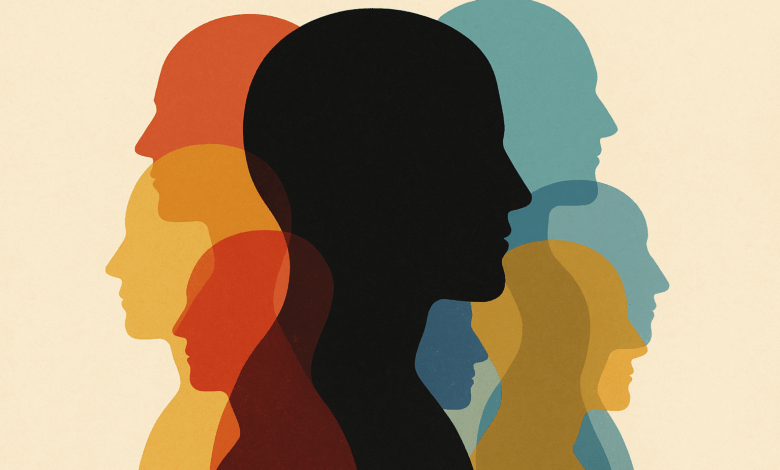
The modern human no longer has a single face. In every setting, a different version of the self appears: one with close friends, another at work, one online, another with family, and yet another in the privacy of one’s own thoughts. This fragmentation might seem like a sign of instability, but psychologists argue that in a world where identities are constantly shifting and being redefined, the ability to move between multiple selves has become a survival skill.
In the past, social identity was largely fixed. A person belonged to a single class, faith, or community. Today, we move rapidly across groups, switching between roles and affiliations. Sociologists say this new condition brings both power and vulnerability: power, because it allows us to navigate a world of diversity and change; vulnerability, because in that movement, we can easily lose our sense of self.
Recent psychological studies have explored the link between social identity and mental health. The results show that people with multiple social identities, when able to integrate them, experience greater security, meaning, and coherence. They feel seen and accepted in different circles, and this multi-layered belonging reduces loneliness and anxiety. But when identities clash or fail to align, the result is stress and confusion; a quiet crisis of who one really is.
Sociologists trace this phenomenon to globalization and the digital age. The modern world exposes us to an overwhelming variety of cultures, values, and ways of life. Social media erases traditional boundaries, so our sense of self no longer forms only through family or community mirrors but through constant contact with the global “other.” The self becomes a reflection shaped by endless comparison and communication, always in motion between roles.
Yet psychology reminds us that collective identity doesn’t have to be a source of conflict. When a person can make their identities converse – rather than compete – they achieve a more stable sense of self. In today’s world, identity isn’t something we have; it’s something we build. And that building never stops; it continues through every relationship, every choice, every day.
Ultimately, the modern person seems to be searching for a “fluid belonging”: a way to be part of many groups without losing individuality. We move constantly between being ourselves and being part of others, and within that movement, we discover a new meaning of what it means to exist.
Sources:
Hu, J. et al. (2024). Social Identity and Social Cohesion: A Meta-Analytic Review. Frontiers in Psychology.
Ramos, M. et al. (2024). Multiple Social Identities and Well-being. British Journal of Social Psychology.