a World of Imagination: A Look at the Psychological Fantasy of A Big Bold Beautiful Journey

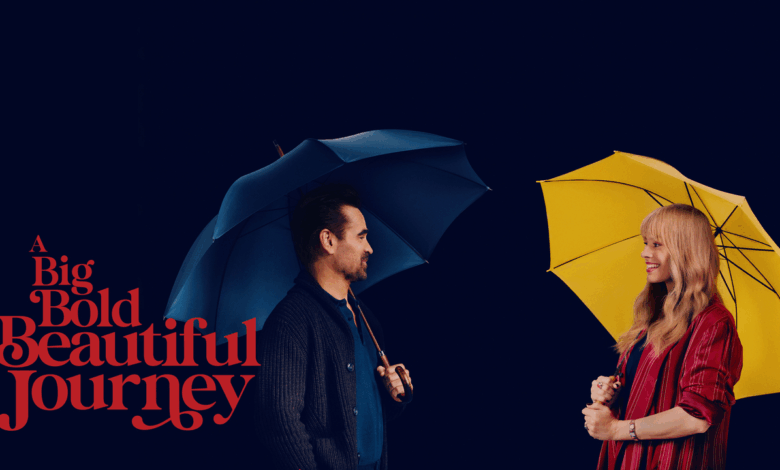
When I found out that Phoebe Waller-Bridge was in this film, I was genuinely excited — her performances always bring a mix of sharpness and vulnerability that’s hard to find elsewhere. But that excitement faded quickly once I realized she appears for barely five minutes. It’s a bright spark that disappears too soon. Still, the overall acting across the film was solid; not outstanding, but consistent enough to hold the story together.
What really stays with you is the tone of the film. A Big Bold Beautiful Journey moves somewhere between fantasy and realism, building a world that feels at once whimsical and grounded. It opens with the question, “What if you could revisit one decisive moment in your life?” and spins that idea into a cinematic maze where memory, regret, and second chances blur into one another. The sets are luminous, the transitions dreamlike, and the emotional temperature hovers between wonder and melancholy.
The film’s central idea is strong, but it’s also where some of its problems begin. It tries to pack too many psychological themes into one narrative: the fear of failure, the weight of memory, the urge to rewrite the past, the fantasy of healing. Instead of letting these ideas unfold organically through character and emotion, the film tends to construct them too visibly; almost like a psychological puzzle assembled in front of you. That structural overexposure weakens the emotional impact. You feel the design more than the feeling.
Visually, though, the movie is stunning. Director Kogonada and his team have crafted a delicate balance between surreal imagery and believable environments. The glowing doors, the reflective cars gliding through strange luminous streets, the floating details that seem to breathe; all of them show a filmmaker obsessed with texture and rhythm. The production design and cinematography merge into a hypnotic visual poem. Even if the story doesn’t fully resonate, your eyes are constantly rewarded.
But when the visuals take center stage, the characters sometimes fade. The performances, while competent, rarely pierce through the film’s surface beauty. They become symbols rather than people. You admire the composition, the editing, the dream logic; but you miss the warmth of imperfection that makes a film human.
Audience ratings for A Big Bold Beautiful Journey were notably lower than expected, and I think I understand why. Viewers sensed the distance between the film’s emotional intention and its execution. It wanted to be about psychological truth, yet it staged that truth instead of living it. The architecture of meaning was perfect; but the pulse beneath it was faint.
Still, I wouldn’t call it a failure. There’s genuine vision here, and a tenderness beneath the design. The movie feels like an artist’s sketchbook turned into a dream; sometimes messy, sometimes self-conscious, but always sincere. And even if Phoebe Waller-Bridge’s brief appearance left me wanting more, those few minutes were luminous enough to remind me how much charisma she brings even in passing.
In the end, A Big Bold Beautiful Journey is exactly what its title promises: big, bold, and beautiful; but also fragile. It’s a film about imagination and control, about how we try to rebuild our inner worlds after they’ve collapsed. Watch it for the craft, for the colors, for that surreal sense of possibility. Just don’t expect every idea to land. Sometimes the beauty is the point, and sometimes the journey matters more than where it ends.