Film Information
Title: The Teachers’ Lounge
Director: İlker Çatak
Cast: Leonie Benesch, Eva Löbau, Michael Klammer
Year: 2023
Genre: Social / Psychological Drama
Country: Germany
From its very first minutes, The Teachers’ Lounge feels calm and methodical, yet beneath that calm lies an almost unbearable tension. It begins with a simple situation – a new teacher, a school, and a small suspicion – and slowly expands into a study of morality and human judgment. I realized early on that this wasn’t going to be a sentimental film, but a careful, intelligent exploration of how fragile our sense of justice can be.
İlker Çatak’s direction is masterful. He avoids melodrama, instead building tension through silence, rhythm, and framing. His camera moves gently but purposefully, following the characters through hallways and classrooms that feel less like a school and more like a mental labyrinth. Every shot is intentional; every pause has meaning. The result is a film that feels alive, alert, and quietly suffocating. You can’t look away because it always seems that the truth is hiding just outside the frame.
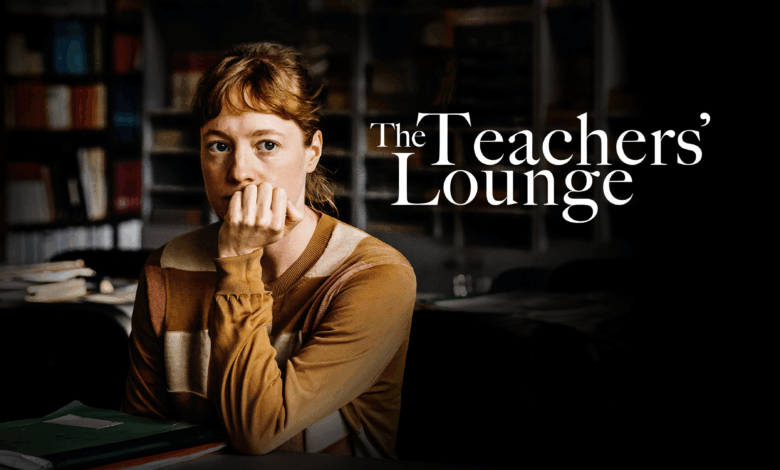
Leonie Benesch, as Carla Nowak, carries the entire film on her shoulders. She plays a young teacher caught between justice and loyalty, truth and perception. When a series of petty thefts disrupt the school, Carla’s attempt to uncover the truth sets off a chain of suspicion and conflict that spirals beyond her control. Benesch’s performance is remarkable for its restraint; she doesn’t dramatize; she inhabits. Every flicker of doubt in her eyes reveals more than pages of dialogue could.
The film’s concept is brilliant: using a confined school environment to explore the moral ambiguity of truth. Çatak turns the ordinary setting of a teachers’ lounge into a microcosm of society, where everyone believes they’re right and yet no one really listens. The world he builds is exact, detailed, and painfully familiar. From the sterile design of the classrooms to the careful rhythm of conversation, every detail feeds into the atmosphere of quiet unease.
The screenplay is equally strong. Nothing feels accidental; every development emerges naturally from character and circumstance. The film resists preaching or offering easy answers. Instead, it invites the viewer to step into the moral gray zone and ask: what would I have done? How far can you go in defending truth before you destroy trust?
By the end, The Teachers’ Lounge becomes more than a social drama; it becomes a meditation on perception and responsibility. It’s a film about how quickly trust can crumble, how one small act of righteousness can ignite suspicion, and how difficult it is to do the right thing when everyone is watching.
Technically, it’s near perfect: Çatak’s controlled direction, the sharp editing, and the natural performances all work together seamlessly. But what makes the film unforgettable is its emotional honesty. It doesn’t give you resolution; it gives you questions.
Watching The Teachers’ Lounge feels like standing in a hallway lined with half-open doors. Behind each one might lie truth or misunderstanding; and you’ll never know which until it’s too late. That’s the film’s quiet genius: in today’s world, even inside a small school, finding the truth is no longer simple.