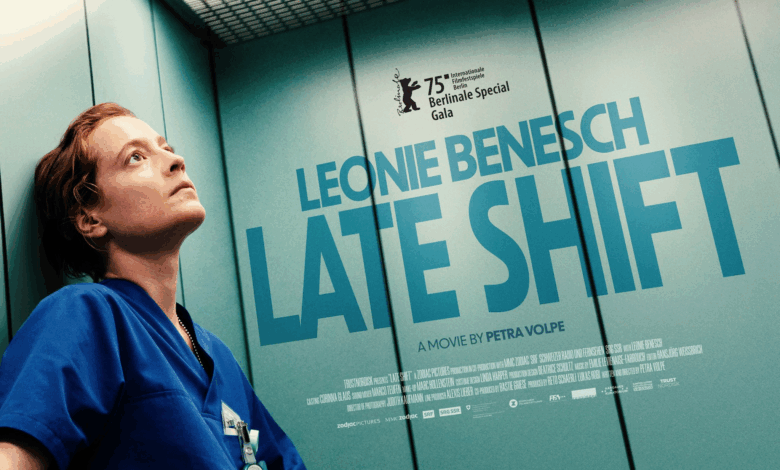
From its very first frame, Late Shift presses down on you with the full weight of exhaustion. Nurse Floria, played with remarkable precision by Leonie Benesch, begins her night shift in a Swiss hospital already trembling under the strain of understaffing. The camera follows her down bright sterile corridors; the machines hum too loudly; every sound seems to pulse with urgency. Within minutes, it becomes clear this is not a typical night—it’s a race against time, fatigue, and collapse. Director Petra Biondina Volpe refuses to give the audience a single breath. Every scene tightens the rhythm, every gesture adds another layer of tension, until you find yourself gasping alongside the protagonist.
The film’s genius lies in how it uses pacing as an emotional tool. In the first half, Floria moves between tasks—changing gowns, administering medication, consoling an anxious mother—while the call lights keep blinking. Her world is clinical and merciless, but never cold. Benesch hides anxiety behind a facade of calm professionalism, allowing the cracks to show only when the pressure becomes unbearable. You can see her slowly reaching that point where the boundary between duty and despair dissolves. The fatigue you feel as a viewer is exactly what the film wants you to feel—it’s empathy through exhaustion.
Visually, Late Shift transforms the hospital into a living, breathing organism, beautiful and brutal at once. Cinematographer Judith Kaufmann uses harsh fluorescent light, slick linoleum floors, and restless camera movement to make the space feel inescapable. When things go wrong, the camera trembles, closing in on Floria as though the walls themselves are closing in. There’s no safe space, no quiet corner to hide. The film’s look mirrors its subject: a world where care itself is both sacred and suffocating.
Beneath its personal story, the film carries an unmistakable social critique. It’s not just about one nurse’s bad night—it’s about an entire system on the verge of collapse. The overworked, underpaid healthcare workers, the emotional labor no one counts, the invisible toll of compassion: these are not background details but the film’s oxygen. Volpe has said she wanted to “pull the human face of caregiving out of the statistics,” and she succeeds completely. Watching Late Shift feels like being reminded, painfully, of how easily a society forgets those who keep it alive.
Then, after more than ninety relentless minutes, the rhythm finally breaks. Floria steps outside the hospital. The city is still. The night is cold. For the first time, there’s silence. That moment feels like a deep inhalation after nearly drowning. The sudden deceleration is not comfort but clarity—it forces you to process what you’ve just lived through. The stillness is as loud as all the alarms that came before.
Critics have been divided. Peter Bradshaw wrote that the film sometimes approaches the texture of a TV melodrama, but he praised Benesch’s performance as “tough, smart, and deeply believable.” Many European reviewers, however, hailed it as one of the most honest portrayals of modern healthcare ever put on screen. What unites both camps is recognition of the film’s rare emotional authenticity—it doesn’t exaggerate suffering; it simply refuses to look away.
Late Shift is not an easy film to watch, but its difficulty is its meaning. It demands participation, just as caregiving itself does. There are no heroic resolutions at the end, no grand catharsis. There’s only a woman still standing, her eyes tired but alive.
Ultimately, Late Shift is not about work; it’s about endurance—human endurance in a system that never stops spinning. Floria may not save anyone, but she saves herself from numbness, and that small act becomes monumental. When the film ends, the hum of hospital machinery still echoes in your mind, but beneath it, one truth remains: care, in all its fragility, is still the most profoundly human act we have.